Mini Book Review: 'Autobiography of Red'

Yes, it's the tale of a little gay dragon-monster discovering his purpose in life, falling in and out of love, traveling to South America, growing as an artist (photographer), and . . . Well, it's hard to explain. And the fact that it's told in the form of an epic poem may make many readers worry that the book is going to be a homework-like chore to read. But, really, it's not homework at all -- after a few pages you'll get into the rhythm of the writing and discover a funny, fast, moving, disturbing, exciting, and totally unexpected story of the highest caliber.

So don't feel daunted when you hear that the "Autobiography of Red" is an experimental and intellectual book that is, as Wikipedia puts it, "a verse novel by Anne Carson, based loosely on the myth of Geryon and the Tenth Labor of Herakles, especially on surviving fragments of the lyric poet Stesichorus' poem Geryonis." True, it's that as well, but it's also a contemporary, genre-bending, fantasy-laced, oddly relatable, and very enjoyable weekend-read that you'll remember for a long time to come.


Search Amazon.com for Anne Carson

Mini Book Review: 'Our Band Could Be Your Life: Scenes from the American Indie Underground 1981-1991'

"Our Band Could Be Your Life: Scenes from the American Indie Underground 1981-1991" is one of the top rock books I've read -- funny, inspiring, well researched, and insightful all at once. Since there are already tons of reviews out there on the Internetziz that go into plenty of critical and general detail, I figured I'd just give a quick summary of what's featured in the book:

The main bands profiled: Black Flag, The Minutemen, Mission of Burma, Minor Threat (Fugazi), Husker Du, The Replacements, Sonic Youth, Butthole Surfers, Big Black, Dinosaur Jr.

Secondary subjects: Nirvana, Pearl Jam, Henry Rollins, Sebadoh, Steve Albini, SST Records, K Records, Sub Pop Records, the birth of punk and hardcore and straight-edge, various `zines, underground and indie scenes, and producers, musicians, influences, etc...

Quite humorous and harrowing, with awesome insider-interviews and wacky anecdotes, including a drunken cameo by Alex Chilton (of Chris Bell, Box Tops, and Big Star fame). Put this one on your bookshelf for some serious indie cred.

Search Amazon.com for more books related to Our Band Could Be Your Life

Album Review: 'Skull Ring' - Iggy's POPular comeback - running rings around modern punk

Overall, this album may not be as raw, visceral, and fresh as Iggy Pop's early work -- and some of it seems a bit forced and a few of the collaborations border on sell-out territory or the completely forgettable (I'm thinking of the Sum 41 duet especially, but that ended up being one of the album's biggest hits, so when even the cheesiest track is a hit, you know the other stuff will rock) -- but in the end it's a helluva lot a fun, rocks like crazy, and brings back a power and energy lacking from Pop's more low-key solo work of recent years.

And the Stooges are back on some tracks! Such a longed for reunion mixed with cool guest stars and lots of energy. Overall, an exciting little album. Still, where Mr. Pop still rules is LIVE ... if you ever get a chance to see him perform at a stadium, club, or outdoor show, RUN, don't walk. It'll be worth every penny, even if you've never loved his live or studio albums... watching this man onstage, even in 2004, is like a fever dream of power and vitality.

After seeing some of the "Skull Ring" tracks performed live by the reunited Iggy & the Stooges (and, lately, with the great Mike "Minutemen" Watt on bass), it becomes clear that "Skull Ring" actually fits in perfectly with Iggy's seminal punk from the early '70s... somehow, this aging dude is still knocking out new material that cuts as deeply as the old... And at it's best, "Skull Ring" stands with the classics.

For your enjoyment, here's the breakdown of Iggy Pop's "Skull Ring" collaborations. If I've left anyone out, leave a note. (Also, check out the "FatherFu****" album by Peaches for another good Iggy Pop-Peaches duet):

Little Electric Chair (with The Stooges)
Perverts In The Sun (with The Trolls)
Skull Rings (with The Stooges) {alternate title: "Skull Ring"}
Super babe (with The Trolls)
Loser (with The Stooges)
Private Hell (with Green Day)
Little Know It All (with Sum 41)
Whatever (with The Trolls)
Dead Rock Star (with The Stooges)
Rock Show (with Peaches)
Here Comes The Summer (with The Trolls)
Motor Inn (with Peaches)
Inferiority Complex (with The Trolls)
Supermarket (with Green Day)
Till Wrong Feels Right {Iggy Pop solo}
Blood On My Cool (with The Trolls)
Nervous Exhaustion (with The Trolls) {hidden bonus track}


Audio CD:


MP3 Digital Download:

Search Amazon.com for Iggy Pop

Eastdown and Bound


"Eastbound and Down" is not yet the greatest show in the world, but it’s worth checking out. It’s got a weird tone – partly wacky redneck stuff; partly absurdest stuff that you’d expect from the FunnyOrDie and "Foot Fist Way" guys; partly dark, depressing Tennessee Williams Southern-Gothic drama; and "George Washington" realism mixed in with  drug humor and social satire. All packed into under 30 minutes.

It’s weird when someone like Will Ferrell shows up as a guest star on the show, because the character he plays is a totally hammy FunnyOrDie type (e.g., SNL-style Comedy Acting + Over-the-Top Vulgarity) that is at once both awesome and entirely not fitting within the context of half the other plotlines, which involve the main character having problems with drugs, alcohol, steroids, and an inability to emotionally connect to people, a flat-lined career, etc. One moment you see the lead guy getting crushed by life; and the next moment you see him doing wacky cracker shtick opposite other purposely over-the-top actor-comedians. The show bounces around like this constantly.

The one-sentence pitch: It's like “Rosanne” meets “The Glass Menagerie” meets FunnyOrDie’s “The Landlord” meets "North Dallas Forty" meets “My Name is Earl,” if “My Name is Earl” was an R-rated movie by Kevin Smith instead of a Scientology-karma network sitcom.

It makes it hard to judge whether or not the show is good or bad. After four or five episodes I’m still not even sure if I like, love, or hate it. But I’ve gotta admit: It’s different, and it sometimes zigs in a different direction when you expect it zag somewhere else; not just plot-wise, but on an emotional and thematic level. And that makes it exciting for a sitcom.

I’m curious to see whether or not the show gets better or worse. Seems like it could be improved upon (balancing the comedy/drama and reality/absurdity better, working on the pacing, expanding the cast), but the current Redneck Man-Child Learns to Become a Real Man and Regains His High School Sweetheart routines will wear thin pretty quick if the show doesn’t figure out what arc to take the characters on next.

That said, after “Lost,” “Fringe,” “Flight of the Conchords,” “30 Rock,” “Underbelly,” “Damages,” and “The Office,” I’d have to say that “Eastbound and Down" is one of the best shows currently on TV, at least until "Ashes to Ashes" and "Curb Your Enthusiasm" bring forth their new seasons.

Caffeinated Contents & Luscious Links

For years I'd been carefully organizing the best Celebrity Cola links into a slick CSS/Java/HTML-styled table-of-contents. On the front end, it was just a cool, fast, elegant-looking interface. On the backend, the code was based on the work of Nick Rigby, the Drupal "Nice Menu" project, and others, and I'd layered in some little Easter Eggs of my own.

The menu boiled down hundreds of external and internal links into a little 12-item box that didn't look like much until you hovered over one of the main categories -- at which point the little category arrow would bounce and a whole new list of sub-categories would zoom onto the screen, with sub-sub categories folding out from there. Alright, so maybe that sounds lame. But, no, seriously, it was pretty awesome, as far as text-heavy drop-down/pop-out menus go ;|)

However, it was a pain to update. So I'm finally switching over to the built-in organization and navigation options offered by Blogger (collapsible archive lists, labels/tags, link-lists, news-feeds, etc.).

As a memorandum, I figured I'd drop the latest, greatest, and final version of the old "nice menu" table of contents code into a blog post. However, it's playing absolute havoc with a few of the new Blogger widgets I just added, and various style sheet conflicts are popping up, so I'm throwing in the towel. Instead, here's a really craptacular ol' ol' skool version of the previous Celebrity Cola Table of Contents & Related Hyperlinks:

You Can Put Lipstick On a Frog, But You Can't Make an Amphibian Balance the Budget


Yeah, that's right, I haven't posted anything new here in an eon.... Wanted to, just haven't had the time. But for better or worse, for at least this one post I am so back, tootsie.

Check it out:

YouCanPutLipstickOnAPig.com

A new low for bad comedy? Yowza.

Blame the Brachish.

Luckily, Margery Eagan has a far more intelligent and informative (but still rather witty) take on the "Lipstick" fiasco than I -- read her Boston Herald article, "GOP draws line in the sand in lipstick" after you check out my (s)wine-induced porker of an Election 2008 lark.

Conservative Presidents Always Tell the Truth (A Guide to Irony)

Word o' da month:

Courtesy of Guardian Unlimited, IRONY is nicely and humorously (if perhaps mostly unironically) explained by Zoe Williams, who aptly notes that one form of irony "states the lie in order to expose the lie," meaning that irony is "a route to truth." The Wikipedia guide to irony ain't too shabby neither. (Note to self: Double-negative sentence constructions are not necessarily ironic, even when intentional). Don't expect a simple "Synonymous with dry, wry, sardonic, ironical, or humorously sarcastic and mocking" definition. Oh no. This is the real deal. It goes for the juggling jugulars of all those that have maligned and misunderstood the true word.

And after you've read all of that, you'll probably want to go back to using "ironic" in the same way you always have, because, heck, the true in-depth definitions of irony are bloody tedious and confusing -- or at least near-impossible to juggle accurately within the personal lexicon of everyday parlance. For instance, if people don't say "irony" (because 98% of people are using it incorrectly) then they'll have to say something like "cynically humorous" or "an inauthentic statement meant for sarcastic effect" or "intrinsically and hyperbolically hypocritical or paradoxical" or "a form of cosmically post-modern cosmic irony" or "negatively-serendipitous and incongruously coincidental compared to what one might expect" instead -- all of which are mighty cumbersome.

So forget irony.... just so long as people use the word "literally" correctly, I'm happy. Because that's a misused word that really drives me soup-to-nuts. Literally. (Well, maybe not literally; but it's more irritating than listening to a Chipmunks musical version of "Mein Kampf.")

***

Key quotes from Zoe Williams' 2003 Guardian article, "The Final Irony," linked above:

In regards to the so-called "ironic" viewpoint of most lad mags, much of reality TV, celeb gossip rags, and the like: "[They're saying] 'I'm not saying what you think I'm saying, but I'm not saying its opposite, either. In fact, I'm not saying anything at all. But I get to keep the tits.' ... So, we're not the first age to use irony (as some insist), but we are the first to use it in this vacuous, agenda-free and often highly amusing way." On the other hand, it's not all fun and games, as Williams goes on to note that in the more traditional sense of the word, "America having funded al-Qaida is ironic; America raining bombs and peanut butter on Afghanistan is ironic." Ouch. Those Pommy Brits know how to rub it in....

***

(For pointing out an important typo in this post, shout-outs go to Zennist.)

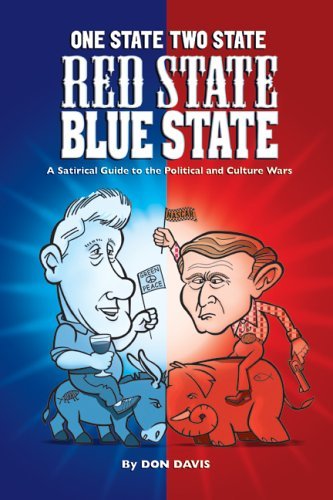
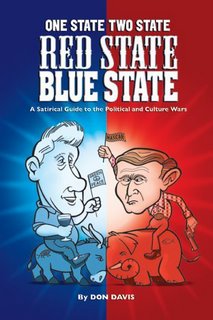
One State Two State, Red State Blue State

Poetry and limericks were replaced in popular culture by television, music lyrics, and cultural consumerism long ago. But just as modern-day poets keep fightin' the good fight and Anne Carson successfully reinvigorated the epic poetic form with Autobiography of Red, scribes such as Don Davis are struggling to bring back the art of rhyming satire.

Thus, Davis' One State Two State, Red State Blue State: A Satirical Guide to the Political and Culture Wars is a bold attempt to render contemporary American society in rib-tickling verse. But how receptive, really, will today's society be?

To quote the ever-present Sex and the City, wherein lead character Carrie Bradshaw's erudite suitor tries to turn her on to the finer aspects of metric verse:
Carrie: How about I read you a little bit of my favorite poetry?

Aleksandr: Please.

Carrie [Reading from a Vogue magazine]: "Cocktails at Tiffany's calls for classic charm. Oscar de la Renta, sleeveless silk full-skirted dress with black patent leather bow belt." Now that is pure poetry.
Ah, yes: products and fashion. That is poetry to many. Or should I say, "too many"? Red State Blue State, then, may be a change of pace that not everyone can appreciate. But for those willing to plunge into the depths of Davis' old-school comedy stylings, many chuckles await, with chapter headings along the lines of "Was Jesus Red or Blue?," "Can There Be a Culture War Without Any Culture?," "The Age of A-queer-ius," "Iraqnaphobia," and "Desperate Democrats" signaling the many topics being wittily marinated, skewered, and barbequed.

If Red State Blue State has a weakness, it namely lies within its timeliness: Jokes about Bill Clinton and Al Gore are already growing dreadfully stale, pop-culture references quickly lose bite, and John Kerry is barely a memory. Once George W. Bush and the current crop of congressmen leave office, Red State Blue State will likely lose its relevance.

And yet it's hard to fault the writer for this failing since it's the same trap that snares most of-the-moment cultural and writing—becoming timeless while staying timely is near impossible. The book is funny because it's timely, but that timeliness is also what marginalizes the material since you have to understand its social and historical context and it's many little news references in order to get the jokes.

On the other hand, if Hilary Clinton and/or Jeb Bush run for the presidency within the next decade and the Iraq War and Al Qaeda terrorist conflicts remain unresolved—all of which seem likely—then Bush, Clinton, and Mid East gags will automatically become relevant all over again, so Red State Blue State may be able to keep some of it's edge for a few years to come.
That said, the best time to read the book is now, while it's still fresh. And when you're done flipping through it, it'll make a perfect little gift for your hard-to-shop-for political-fanatic compadres. One caveat: Although Red State Blue State heckles both the left- and right-wings of society, the book saves it's sharpest and most frequent jabs for the conservative right (the author is a New York Blue Stater). For me, that's perfect. For namby-pamby Republicans, it might be a problem.

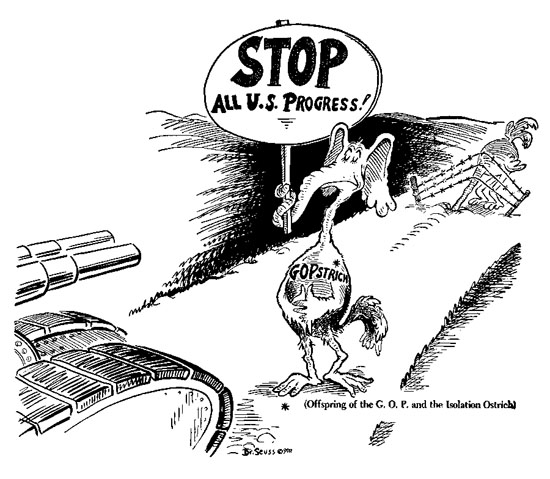
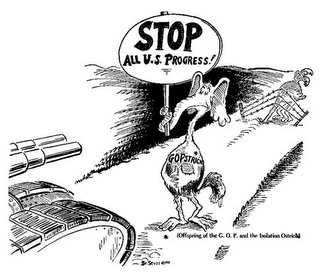
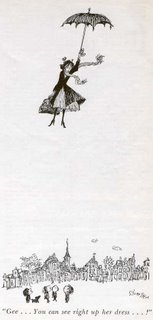
Political affiliations aside, it's of interest to remember that Red State Blue State has antecedents in the works of famed wordsmiths like Shel Silverstein and Theodore Geisel (Dr. Seuss), who wrote rhymes for children that appealed across generations, but also worked in the realms of social and political satire. In turn, this makes me wonder if Davis should have taken a cue from those esteemed men and laced his verse with inventive drawings.

Clever illustrations would make Red State Blue State a superior gift and worthy coffee table piece. The most memorable Silverstein and Geisel works, editorial cartoons, Joel Andreas' hilarious and frightening Addicted to War graphic novel, and illuminate biblical scriptures all benefit from artistic renderings juxtaposing against text, and the lack of detailed, risible art is what makes the numerous pages of Red State look more imposing and less entertaining than its lighthearted contents actually are.

I'll close this review by stealing the inscription from the opening of Red State Blue State: "You can't make up anything anymore. The world itself is a satire. All you're doing is recording it." – Art Buchwald

Like Red State Blue State, that quip is witty, sad, and awfully, wryly, kinda true.


Excerpts:

Hardball, Crossfire, The McLaughlin Group
All yelling at the top of their lungs
Would the national dialogue be better served
If we simply cut out their tongues?
But on second thought, all this white noise
Really does serve the nation
After all, man can't live by smut alone
He also needs mental masturbation...

...The media's coverage of politics
Is usually like a horserace
Who's up, who's down, who's leading the pack
Who's falling down on their face
But if an ambitious reporter attempted
To boil down a candidate's views
She'd find herself off the network
Covering cooking on the local news...

...But for those truly worried
About the Red/Blue Divide
It's not quite time
For National Suicide
With erectile dysfunction
And wardrobe malfunction
This whole country may be obscene
But one thing is clear
What we all hold dear
Is not Red or Blue, but the GREEN.
***

Related:
Check out "Dr. Seuss Went to War" (political cartoons) and "The Advertising Work of Dr. Seuss," both curtesy of the Mandeville Special Collections Library's Dr. Seuss Collection.

Also, many of Shel Silverstein's adult works were stored at Banned-Width.com (regrettably this website disappeared at the end of 2006, but most of the site's content can still be found via the web.archive.org Internet Archive Wayback Machine), while info on his magical children's books can be found at ShelSilverstein.com.

And author-lawyer Don Davis has a new blog up and running, The Satirical Political Report: An Offbeat Look at the Hot-Button Issues of the Day.

***

Note: The review portion of this post will be mirrored at Blogcritics.org and Amazon.com.

Et tu, Coulter? (Repub Nutters Have Bush's Back)

Our story thus far: The politically right-wing, so-called-conservative Republican Party has obtained unprecedented power in the United States of America, having gobbled up top spots in courts across the land and both houses of congress, in addition to landing George W. Bush a second term as president of the country.

Now, secure in their supremacy, Republicans with so much as even an ounce of ethical morality and/or half a brain feel confident that occasionally they can speak the truth about the hypocrisy and financial absurdity rife within the Bush/Cheney Administration. However, not all True Believers of the supposedly God-loving, "normal guy" Bush are ready to hear any remarks of ill repute concerning their Beloved Leader. Thus, many conservative commentators have taken to sugarcoating their Bush jabs with left-wing/liberal jokes to help the medicine go down:


Alright, so I just read the updated version of "Kwanzaa: A Holiday From the FBI," an anti-liberal and anti-Kwanzaa screed by Ann Coulter, author of How to Talk to a Liberal (If You Must) and other grandiose wackiness loved by Repubs and loathed by Dems. Her unraveling of the possible truth behind Kwanzaa was originally written back in 2001, I believe, but the article gets passed around maniacally every year during the holiday season, and thus it's back once more. (Originally the column began by referencing President Clinton's Kwanzaa greeting; now it references Bush's nearly identical greeting) .

Good ol' Coulter is a funny writer. Witty. And she can be so lambastic, I often wonder if she's not a liberal secret agent determined to make the right look bad by proclaiming herself conservative while acting like a nut. (A brief aside: I was hoping that I'd just coined the term "lambastic" -- a combination of bombastic and lambast -- but it looks like this word is used frequently all over the Internet. Everywhere but in dictionaries, that is.)

For instance, I'm a far-left liberal. A socialist with certain libertarian leanings and a Green-party voting record. I live in NYC and work in the media and arts. And I don't have anything to do with Kwanzaa on a regular basis. So why does Coulter say this is "a holiday for white liberals, not blacks"? Who are these mythical liberals that the wide-eyed Republicans are always blathering on about?

Look, I'll admit this: The facts the author presents are little known by many, and thus should be discussed; she compiles the information nicely; and I love a good FBI conspiracy theory as much as Ann Coulter does.

But here's the rub: Although I'm not anti-Kwanzaa and I'm on the opposite side of the political spectrum from Coulter, I coulda written this very same article and would have had many of the same things to say (if I was in a cynical, paranoid, conspiracy-minded, "the FBI and CIA are behind everything" mood, which isn't rare, exactly).

The only difference in how I'd have written the piece is that I wouldn't have kept haphazardly throwing the blame on so-called liberals every three paragraphs. But I guess that's why Ann Coulter makes the big bucks: she can twist any topic into a liberal vs. conservative showdown. It's like butter on steak: it may not be healthy, but it just tastes so much better.

But wait.... Coulter keeps mentioning George W. Bush over and over again. She never says anything bad about him. And yet, I do believe she's implying he's part of the liberal conspiracy, isn't she? I quote: "Bush called Kwanzaa a holiday that promotes 'unity' and 'faith.' Faith in what? Liberals' unbounded capacity to respect any faith but Christianity?"

Yeah, that's right, she just took a statement made by Ye Conservative Republican Christian Leader G.W. Bush and, without taking a breath or a pause, twisted his words into a slap down of liberals, with the undeniable implication that Bush is the liberal getting slapped. Did you notice? What about when she called Bush's own words "patently absurd." Can she talk about a president like that?

Let's break it down and look at the actual Kwanzaa statement by Bush (an annual bromide that has been more or less the same for years now), and then put Coulter 's reply in context. Pretend this is a dialogue (the quotes are all real, but edited):

Bush: "I send greetings to those observing Kwanzaa.... The seven days of this celebration emphasize the seven principles of Nguzo Saba -- unity, self-determination, collective work and responsibility, cooperative economics, purpose, creativity, and faith. As families and friends gather for Kwanzaa, Americans remember the many contributions African Americans have made to our country's character and celebrate the diversity that makes our Nation strong. May your commitment to family, faith, and community thrive during this holiday season and throughout the coming year. Laura and I send our best wishes for a happy Kwanzaa."

Coulter: "With his Kwanzaa greetings, [the president] is saluting the intellectual sibling of the Symbionese Liberation Army, killer of housewives and police. He is saluting the founder of United Slaves, who were such lunatics that they shot Panthers for not being sufficiently insane -- all with the FBI as their covert ally.... Faith in what? Liberals' unbounded capacity to respect any faith but Christianity?"

Brachish: "Now, Ann, that wasn't a liberal that just gave his blessing to Kwanzaa. That wasn't a Kennedy or a Clinton. That was George W. Bush a.k.a. Bush Jr. a.k.a. Bush II a.k.a. Nixon-Reagan-Lite. Be polite to yer captain, lady. You're not mad just because you heard that George's brother -- Gov. Jeb, the Republican hoped-for heir to the 2012 presidency -- believes in evolution, are ya?"

Anyway, it's good to know that Ann Coulter and her conservative Republican talk-show ilk are up in arms about a little-respected, marginalized holiday that was invented in the time of tie-dye.

For a while there I was worried that they might be getting bored with the nearly 25 years of Executive Branch power the Republicans have held since the 1970s -- so bored that they might start worrying about the massive deficit the Republicans have dug our country into, the unimpressive stock market, the stumbling U.S. businesses, the corrupt corporate leaders ("conservatives" one and all), or the war that's brought us neither safety nor profit (well, if you happen to have connections to the Texas oil industry you're up to your armpits in high-priced domestic oil money, thanks to our Mid East wars driving up Texas oil prices just like they always have and always will; but that's another story, one that certainly has nothing to do with Bush and Cheney's many domestic oil friends).

But no, there's no reason to worry about those things. Not when we can still bash the liberals for, uh, threatening to bring health care to both the rich and poor. Damn liberals. They so crazy.

Geeking Out on Graphic Art, Sidling Up to Sci-Fi

I just stumbled across MonkStyle.net, the website of Aaron Booth, a Sydney, Australia-based web designer that was trained as an illustrator at Joe Kubert's renowned World of Cartooning (NYC). In addition to the expected ranting and comic book musings, his blog contains links to his eye-catching drawings and photographs.

Some of the art is suprisingly amateurish considering his training (not bad, just a little flat) -- but a great deal of the newer material is staggeringly good, especially his Flash/Illustrator work that transforms mundane photogaphs into vector images that rival the best comic book artistry I've ever seen (and I've seen oodles, let me tell ya).

Booth (aka Dr. Snafu) is particularly apt at capturing a sense of emotion in the silent pauses and glimmering eyes of his portraits. If he can sustain this level of quality over the course of sequential panels and action sequences -- and mix in some delicious backgrounds -- then illustration wunderkinds such as Josh Middleton and John Cassaday will have a run for their pencils. Do yourself a favor and visit his site for more sumptuous visuals. Or go directly to his Flickr gallery.


(The images above are copyright Dr. Snafu; the other images on this page are copyright their respective owners.)

***

As recently hyped by Wired magazine, Star Trek: New Voyages will be releasing a new Star Trek episode soon. This one staring Walter Koenig, the original Lt. Pavel Chekov. It's amateur fan-boy TV-show freak-out time, as the New Voyage kids finally have one of the real Star Trek actors acting alongside their hazy facsimile versions of Kirk, Spock, and crew.

***


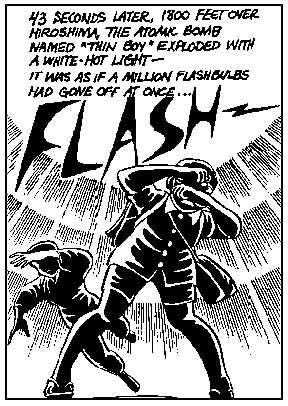
I finally got around to reading the first volume of Keiji Nakazawa's Barefoot Gen: A Cartoon Story of Hiroshima, which was excellent.


Jason Lute's sublime Jar of Fools: A Picture Story and Dan "Ghost World" Clowes' suprising, twisting David Boring were also mind-blowingly superb. And Kyle Baker's Plastic Man: On the Lam! was a wacky, Plaztastic, double-entendre filled surprise.


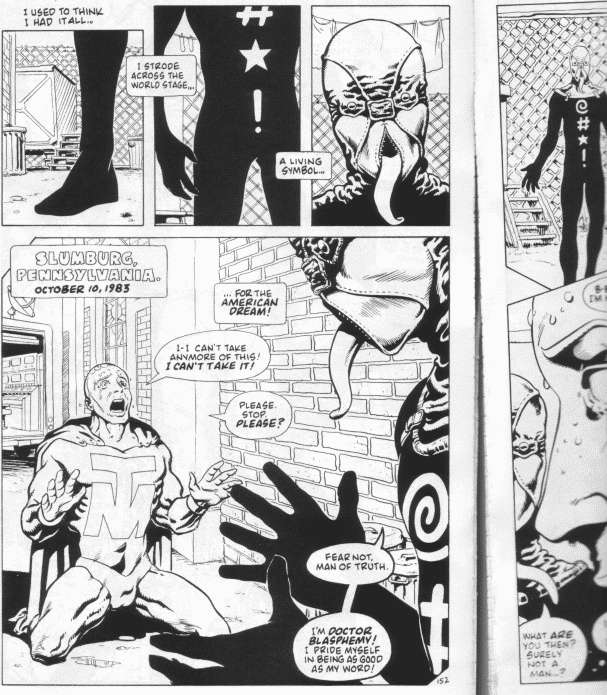
However, Rick Veitch's Maximortal and Brat Pack graphic novels (the first two volumes of the as yet uncompleted King Hell Heroica five-part series) were not as mesmerizing as I'd hoped. Interesting, provocative, gross-out funny, and weird, yes. But not the best revisionist superhero epic in the galaxy (Veitch has had his hand in quite a few classics over the years, notably as an artist, but his solo works never quite reach the pinnacle of such superhero reimaginings as Planetary, the Invisibles, Watchmen, X-Statix, Miracle Man, Sandman, the best of Frank Miller and Alan Moore, even such oddities as American Flagg, Nexus, Zot!, Madman, Concrete, etcetera, etcetera). Brat Pack does offer lush black-white-and-grey artwork, the creepiest interpretation of Batman & Robin you'll ever read, the iconic/archetypal Doctor Blasphemy (one of the most memorable-looking comic creations ever), and the catchy tagline, "Live fast, love hard, die with your mask on."

And storywise Maximortal and Brat Pack tie together nicely while also seemingly forming the backdrop for exciting things to come. But overall the scripting can feel a bit hamhanded and rushed, wallowing in its own dirty jokes and contrivances while never living up to the best ideas and images presented. Maximortal, especially, substitues too much philosophy and psychedelia for action and plot. Perhaps Veitch will pull it all together if he ever gets around to completing his Heroica cycle, but in it's current shape it's a rough (but often rousing) beast best suited only for the hardcore comics fan.

***

Designer Mark Wasserman is Plinko. Plinko is cool. And funny.

Also worth a look is X-Ray Spex, the blog of comics writer/newspaper man Will Pfeifer, "Promising penetrating insight, delivering cheap cardboard glasses"

***

The Sci Fi Channel's online Seeing Ear Theatre has some great new radio-style audio dramas up, like Bebe Neuwirth reading the part of the Queen in Neil "Sandman" Gaiman's Snow Glass Apples.

And 4ColorHeroes offers a ton of links to free, super-rare Alan "Watchmen" Moore online goodies, including lost comics, scripts, MP3s, interviews, prose, and essays.

Reprogramming Science

Rather brilliant Pommy scientist Stephen Wolfram published A New Kind of Science (NKS) back in 2002 to much controversy and acclaim (the text is available online for free). The book shows how simple programs (i.e., sets of instructions underlying biological, computer, physical, and social systems) can produce complex results, and suggests that programs, therefore, can answer questions that traditional mathematics and science cannot.

The concepts can be hard to digest all in one swallow, but the gist is this: math and science wonks like to tackle a particular part of a problem and then reduce it to a very specific formula (say, E=mc²); while computer programmers tend to write very complicated code so that their programs can do relatively simple but specific tasks (like the thousands of lines of coding needed to create a word processing program so you can type up a sentence like this one). But if you write a very simple and general piece of code that doesn't create something very specific, but instead is designed to generate a lot of variations, then the results can be astoundingly complex. This in turn raises the argument that a simple program is a more powerful tool than a simple formula in terms of reducing the math and science of life to its fundamental roots.


The need for traditional mathematics and science still exists, and conventional formulas might be used within the programs themselves, but what is radical about Wolfram’s thinking is that neither creating a super-complex program or searching for the ultimate, compact mathematical formula is going to solve every problem. Instead, thinking in terms of simple programs and the complex results that can result from running those programs over a long period of time might lead to answers otherwise unattainable.

So while biological scientists have been able to figure out that the make up of all forms of known life can be traced back to what is currently called DNA, and the scientists continue to crack the puzzle of various DNA combinations, in the end no simple formula may ever explain how all of the possible DNA combinations relate to each other; but a program, using known DNA code as it’s base variables, could be written that would generate all DNA combinations, and thus help show us the likelihood of, say, a human developing from the muck instead of a dolphin.

For instance, a formula like E=mc² alone will never explain how a turtle evolved from a microbe, but a program could (theoretically) be written to trace the evolutionary development of the turtle's DNA while also generating the thousands of other possibilities of organisms that might have developed under different circumstances.

Anti-evolutionists that have evolved from simple creationist dogma on to Intelligent Design theory hold forth that Darwin's theory of evolution cannot explain the complexity of the creatures that now exist (especially man), so therefore a "watchmaker" (God) must have designed the basic templates. Wolfram's concept, however, shows that very simple programming code could generate all manner of results. Combine Wolfram's concepts with modern DNA studies and Darwin's concept of survival of the fittest and a more defendable view of evolution begins to emerge.

Wolfram sees his theories as being the “new math”—a math that may one day be used to explain the underlying processes that drive biological, social, and physical systems. Life, the universe, the stock market, music, art, sex, cellphone ringtones, etc.: All traceable back to the results derived from instructions (a.k.a. programs) generating all variations of repeatable processes and formulas under a confined set of conditions.

Of course, that’s just my own, highly inflammable, arguably off-the-mark interpretation of his theories. Look into it for yourself and discover the controversy and insight of Wolfram and his contemporaries (and try not to get distracted by all the claims of plagiarism and "I discovered that first" battles flying back and forth between all these modern thinkers, including Wolfram, that are ready to claim a seat of glory next to Einstein, Aristotle, Newton, et al.)

***

Related Post:
"The Apocalyptic Battle Between Science, Religion, Republicans, the Environment, and Those Dreaded Neo-Hippies"

Not Related Post: Brian M. Palmer likes indie music, comics, comedy, and Arrested Development (AD). Thus, he is a good guy. Check out his exclusive and amusing interviews with various AD cast members.

Use It: David Harper recommends TheSage, a stupendous Dictionary-Thesaurus freeware program that trumps most related software I've seen, including some of the better dictionary websites and expensive stand-alone programs. Looking at the results, examples, and cross-references TheSage generates, the word "exhaustive" comes to mind -- although it's certainly not exhausting to use.

I also like the more simplistic, fast-loading WordWeb shareware program-- a powerful, international Dictionary-Thesaurus that you can set up to always run in the background (it doesn't use up much of your computer's resources): Highlight any word in any program and then click ctrl-W and boom!, WordWeb pops up with the definition, correct spelling, related words, etc. I use WordWeb all the time, at home and at work.

Corporate Governance

Most of both houses of Congress, and possibly a majority of high-level politicians these days (especially G.W. Bush and Co.), all seem to operate American affairs the way executives operate global businesses. Which isn't surprising, since so many politicians come from business and law backgrounds, scores having worked as CEOs or for corporate lobbyists and the like. The problem, though, is that modern business has become extremely top-heavy, eagerly rewarding everyone of the executive class regardless of how much work they're doing on a daily basis or how much they're truly contributing to the company overall. And thus that same attitude has crept into government thinking.

Yes, good management can do great things for a company, as can a CEO with vision and passion. But real day-to-day operations are successful based on good middle -management and the quality of the staff beneath them. While executive-level management spends 90% of their time taking meetings where ideas are discussed but nothing is accomplished, and then they all give themselves raises.

Sound familiar? Think it’s just an urban myth? Well, that's the U.S. government for you. And it's Halliburton, GM, and every other corporate business and big-city bureaucracy in the country.

Case in point:

When Delphi Corp. started considering bankruptcy as part of it's efforts to slash auto-worker pay in half and remove benefits from retired employees, they immediately commenced a flurry of meetings, in which the executives decided that, well, all of the executives in the company weren't getting paid enough. Also, if any executives were fired, it was reasonable to assume that they should be healthily compensated with at least six months of pay and a partial bonus. So for the sake of staying competitive in the market place, maintaining quality, and retaining the best workforce possible, the day-to-day laborers and bottom-level management types would have their salaries drastically reduced, while the executives would have theirs raised. What kind of logic is that?

Of course, many people cried foul and Delphi Corp. had to backpedal some. But the fact remains that even after all of the corporate greed and corruption uncovered in the aftermath of the entire 1980s and then, more recently, Enron and its spiritual brethren, companies such as Delphi Corp. will still happily, publicly, boldly, blatantly try to pull off schemes such this where the money of the masses is transferred to the pockets of few.

’Tis not surprising then, that Congress continues to give itself raises and increased health and retirement benefits while also turning down opportunities to bring better health, retirement, and education benefits to the general public. Will a senator or representative a give themselves a raise? Sure. And more power too ’em. But will they raise the minium wage by a buck? Nahhhhhhh....

***

Word of the day: Manichaeism, a philosophy that centers around the concept of dualism (good vs. evil, light vs. dark, yin vs. yang). The ancient religious form of Manichaeism combines Zoroastrian, Christian, and Gnostic beliefs and elements with Babylonian folklore and Buddhist ethics. Also see: Manichaean. Wild stuff.

Comic creator of the hour: Chester Brown, writer-artist of "The Playboy," "I Never Liked You," "Ed the Happy Clown," "Underwater," "Louis Riel: A Comic-Strip Biography," etc.

Site of the minute: Dogsbody, TCJ reviews of art/indie comics, including archived reviews by good ol' NYC-Florida writer Daniel Holloway.

Ms. Hollywood Science, I'd Like You to Meet Mr. Government Bureaucracy...

I just read a blurb in Premiere magazine noting that the U.S. government is offering grants to scientists, in the hopes of sexing up the science industry and recruiting today’s youth into such disciplines as nuclear physics, genetic modification, and other serious realms of scientific study that videogame playing, reality-TV watching, celeb-mag reading Americans are running away from in droves.

But after searching the Grants.gov and U.S. Department of Energy Office of Science grant databases, I was unable to unearth greater details or a grant application. However, a Google search did yield “Pentagon's New Goal: Put Science Into Scripts,” a related New York Times article by David M. Halbfinger:

LOS ANGELES, Aug. 3, 2005 - Tucked away in the Hollywood hills, an elite group of scientists from across the country and from a grab bag of disciplines - rocket science, nanotechnology, genetics, even veterinary medicine - has gathered this week to plot a solution to what officials call one of the nation's most vexing long-term national security problems.

Their work is being financed by the Air Force and the Army, but the Manhattan Project it ain't: the 15 scientists are being taught how to write and sell screenplays ... Exactly how the national defense could be bolstered by setting a few more people loose in Los Angeles with screenplays to peddle may be a bit of a brainteaser. But officials at the Air Force Office of Scientific Research spell out a straightforward syllogism:

Fewer and fewer students are pursuing science and engineering. While immigrants are taking up the slack in many areas, defense laboratories and industries generally require American citizenship or permanent residency. So a crisis is looming, unless careers in science and engineering suddenly become hugely popular, said Robert J. Barker, an Air Force program manager who approved the grant. And what better way to get a lot of young people interested in science than by producing movies and television shows that depict scientists in flattering ways?

... Teaching screenwriting to scientists was the brainstorm of Martin Gundersen, a professor of electrical engineering at the University of Southern California and sometime Hollywood technical adviser, whose biggest brush with stardom was bringing a little verisimilitude to Val Kilmer's lasers in the 1985 comedy "Real Genius."

More recently, he was asked to review screenplays by the Sloan Foundation, which awards prizes for scientific accuracy, and found most to be "pretty dismal," as he put it. "My thought was, since scientists have to write so much, for technical journals and papers, why not consider them as a creative source?" Dr. Gundersen said.... The Air Force is providing $100,000 annually for three years; the Army Research Office has added $50,000 this year....

Dr. Gundersen, meanwhile, offered Valerie Weiss, a participant in the 2004 workshop, as a potential success story. A film buff at Harvard while she was getting her Ph.D. in biophysics, Ms. Weiss switched careers to film four years ago and is now trying to sell a comedy built around a Bridget Jones-like biochemist who applies the scientific method to her hunt for a mate.

She said she hoped her background would give her film the kind of personal touch that Nia Vardalos brought to "My Big Fat Greek Wedding" as a Greek-American. "To write a film that is going to have impact like that, it needs to be from somebody that has direct experience," she said.

Ms. Weiss said Dr. Gundersen's notion that scientists could make good screenwriters stood the test of reason.

"They're inherently creative, and willing to take more risks than other people," she said. "They're searching for the unknown, they're compensated very minimally, they're going on blind faith that what they're searching for is going to pay off. And filmmaking is exactly the same way."

I’d like to argue that a good screenwriter—or a good writer of any sort—can write a great story without having the “direct experience” that Valerie Weiss claims is required. Also, Nia Vardalos’ "My Big Fat Greek Wedding," although highly profitable and occasionally funny and touching, is not a masterwork example of impact-laden cinema. It’s a goofy little comedy.

Writers need to do their homework: reading, research, interviews, and endless imagining. But you don’t have to be a female Harvard science PhD to write a dating comedy about a female science PhD. The education, skills, and experiences of a writer will likely culminate in a better story than a “direct experience” person throwing ideas down on paper. “Direct experience” does pay off with memoir writing, but for romantic comedies and action thrillers? Not so much.

Novelists such as John Le Carré (aka David Cornwell) are the rare exception. Le Carré, a former spy that writes spy thrillers (“The Spy Who Came In From The Cold,” “Tinker, Tailor, Soldier, Spy,” etc.), is probably a better fiction scribe than actual espionage mastermind. And there are others in this vein. Scientists, soldiers, construction workers—great writers come from a variety of backgrounds and day jobs. But the work of a great writer is not limited by his or her past.

The U.S. government should try offering to all writers—not just scientists—encouraging them to write exciting, scientifically accurate science-themed screenplays. And more importantly, programs such as this should help writers find scientists that they can rely on for fact checking and research. Maybe even co-writing.

Imagine that: The federal government hooking up writers and scientists to work together on new projects. Scientists helping writers flesh out their screenplays while writers help recruit today’s kids into the world of hard science. Scientists correcting writers when they lose track of facts, and writers smoothing out the story arcs and dialogue of the microscope gazers and number crunchers.

That would be a worthy program. But ignoring writers while funding scientists to take a break from science so they can learn how to write? That’s nothing more than a study in entropy and thanatology. We might as well start paying screenwriters to design cloning technology in their spare time...

***

Speaking of Scientists: "Life is an anti-climax for some but for most of us it adds up to 16 hours of orgasmic pleasure. Researchers in Germany have calculated that is the number of hours that the average person spends enjoying orgasms during his or her lifetime.... and people spend six weeks doing nothing but playing during childhood, will watch television for a staggering five-and-a-half years ... spend seven years doing nothing but working ... [and] 24 years and four months in the land of nod." -- Allan Hall, "You've got it coming: all 16 hours of it," The Age (Victoria, Australia).

Talkin' 'bout Filmmakers: writer-producer-director Judd Apatow gets focused in an all-out interview conducted by Mike Russell. (Apatow's one of the the new comedy masterminds behind “The Ben Stiller Show,” “Freaks and Geeks,” “Undeclared,” “The Larry Sanders Show,” “The Cable Guy,” “Anchorman,” “The 40-Year-Old Virgin,” “Fun with Dick and Jane.”) Read on...